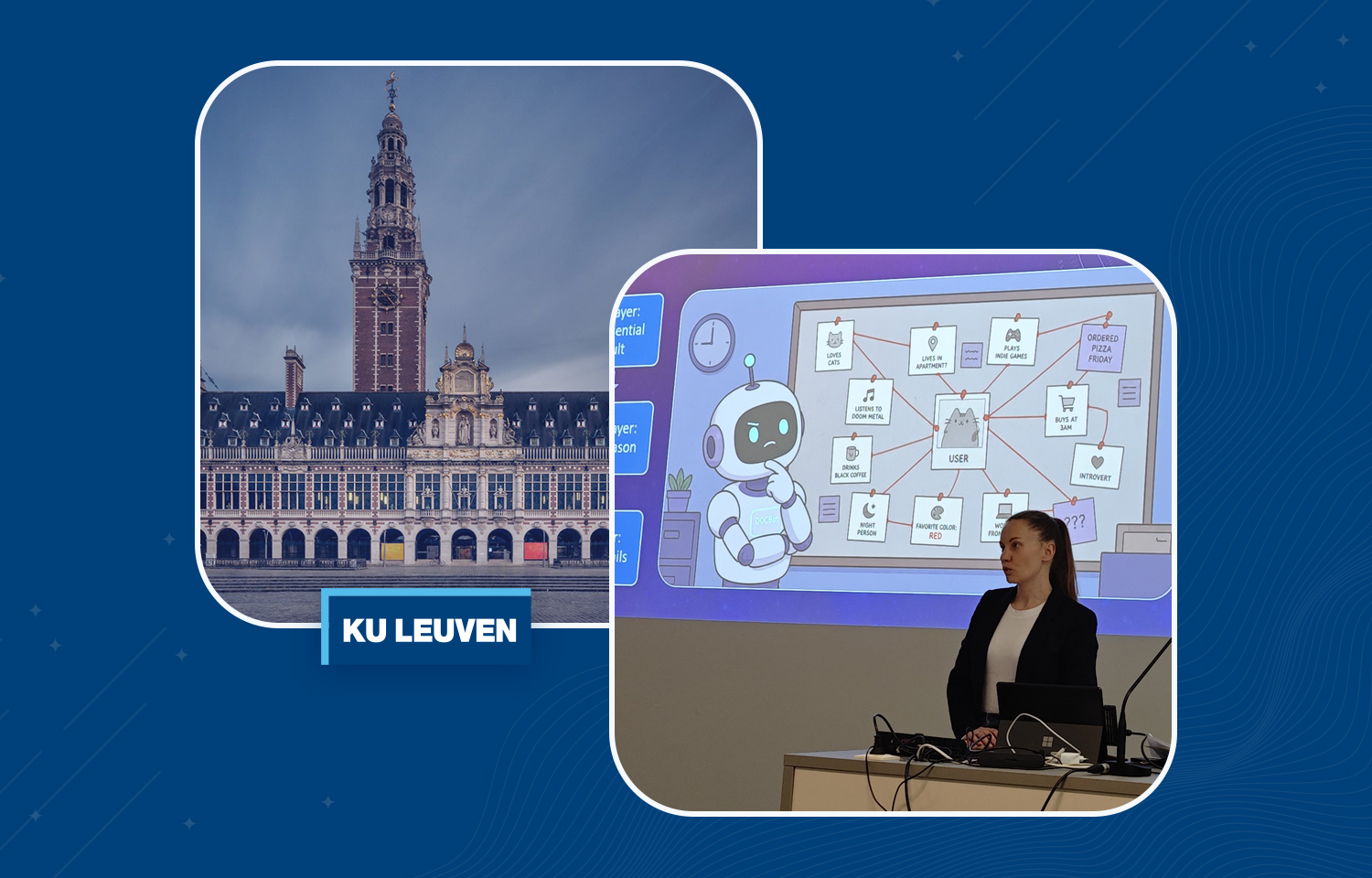
Recently, I had the opportunity to visit KU Leuven in Belgium as part of a short-term academic mobility program – a collaboration between KU Leuven and Zaporizhzhia Polytechnic that has now continued for more than 14 years.
This visit was particularly focused on exploring new directions in AI collaboration, especially around embedded intelligence, applied machine learning, and human-centered AI systems.
From Data to Human Experience
During the mobility, I gave a lecture titled “From Data Analytics to Predictive UX: Designing User-Centered AI Systems”, where I discussed how AI products increasingly move beyond pure prediction accuracy toward understanding human behavior, expectations, and decision-making patterns.
One of the ideas I kept returning to during discussions with students and researchers was that modern AI systems are no longer just technical artifacts. They shape how people interact with information, make choices, trust interfaces, and even perceive reality.
Building intelligent systems without considering UX today feels a bit like designing architecture without thinking about people moving through space.
Working Alongside eAVISE
A particularly valuable part of the visit was working with the eAVISE research group led by Professor Toon Goedemé. Their work in computer vision, audio recognition, and embedded AI highlighted something I strongly believe in: the future of AI is becoming increasingly physical, contextual, and deeply integrated into real-world environments.
Seeing how research teams approach rapid prototyping, interdisciplinary collaboration, and applied AI development inside a leading European university gave me a lot to reflect on personally – not only from a research perspective, but also in terms of education and product thinking.
AI Is Changing Its Shape
One thing that became especially clear to me during this mobility is that the conversation around AI is shifting. We are moving from “Can we build it?” toward “How should humans actually experience it?” And honestly, this changes everything – from interface design to ethics, accessibility, and trust.
The systems that will matter most in the next decade probably won’t be the ones with the most complex models. They will be the ones people can actually understand, trust, and comfortably interact with.
Beyond Academic Mobility
Beyond lectures and seminars, we also discussed future collaborative research initiatives and opportunities for deeper academic cooperation. For me personally, these conversations were probably the most inspiring part of the trip because they opened space for long-term ideas rather than short-term networking.
Academic mobility is often described as knowledge exchange. But in practice, the most valuable thing is perspective exchange. You return not only with notes, contacts, or presentations – but with recalibrated thinking.
Links: zp.edu.ua